-
4 Do You Need Flood Insurance If You Already Have Homeowners Insurance?
For millions of homeowners across the United States, buying homeowners insurance is a natural part of protecting their most valuable asset. It covers fire, theft, storms, and countless other disasters — but there’s a crucial gap in that safety net: floods.
Each year, countless Americans find out too late that homeowners insurance does not cover flood damage. When storms hit or rivers rise, they’re left paying tens of thousands in repair bills out of pocket. That’s why understanding whether you need flood insurance — even if you already have homeowners coverage — can literally make or break your financial security.
This section breaks down when and why flood insurance is necessary, who is required to have it, who should strongly consider it even if not required, and how both policies work together to keep your home fully protected.
Why Homeowners Insurance Alone Isn’t Enough
Your homeowners policy protects against many perils: fire, wind, lightning, theft, vandalism, and even certain types of water damage (like a burst pipe). But there’s one exclusion that’s universal — flood damage caused by external water sources.
This means if a storm causes nearby rivers, storm drains, or coastal waters to overflow into your home, your homeowners insurance won’t pay a single dollar for the resulting damage.
Flood damage is excluded from homeowners policies for one major reason: it’s catastrophic and non-random. A single flood can impact thousands of homes at once, leading to billions in claims that would bankrupt most private insurers.
That’s why flood insurance was created — to fill this coverage gap and ensure that when the waters rise, homeowners aren’t left financially ruined.
The Misconception: “I Don’t Live in a Flood Zone, So I Don’t Need It”
This is one of the most common and dangerous myths in homeownership. The phrase “flood zone” often makes people think only of beachfront properties or houses near large rivers. In reality, flooding can happen anywhere — even miles from a coastline or waterway.
According to FEMA, more than 25% of all flood insurance claims come from homeowners outside high-risk areas.
That means 1 in 4 flood victims live in what’s considered a “low” or “moderate” risk zone. The reason? Modern flooding doesn’t just come from rivers — it also results from:
Heavy rainfall that overwhelms storm drains and city sewers.
Snowmelt that saturates the ground in early spring.
New construction that changes water flow and drainage patterns.
Urban flooding in paved cities where water has nowhere to soak in.
In short, every home has some degree of flood risk — and that risk is growing with climate change and aging infrastructure.
When Flood Insurance Is Required by Law
You might not always have a choice about whether to buy flood coverage. If you live in a Special Flood Hazard Area (SFHA) and have a federally backed mortgage, flood insurance is mandatory.
Your mortgage lender will require proof of flood coverage through either the National Flood Insurance Program (NFIP) or a private flood insurer before approving your loan.
This requirement exists because your home serves as the lender’s collateral. Without flood coverage, a single disaster could destroy that asset and leave both you and the bank at a loss.
Key Points:
Flood insurance is required for federally regulated or insured lenders in high-risk zones.
Coverage must typically be equal to the lesser of the loan balance or NFIP maximum ($250,000 for the building).
Failure to maintain flood insurance can violate mortgage terms and trigger lender-placed insurance, which is often more expensive and less comprehensive.
If your home sits outside of a designated high-risk flood zone, your lender may not require flood insurance — but that doesn’t mean you shouldn’t have it.
Why You Still Need Flood Insurance in “Low-Risk” Areas
Even if you’re not required by law to carry flood insurance, you’re still at risk. In fact, FEMA’s data shows that residents of moderate-to-low-risk areas file 40% of all flood insurance claims nationwide.
Why? Because weather patterns are shifting, urban development alters drainage, and outdated infrastructure can’t always handle heavy rainfall events.
Think about it this way:
You don’t wait until you see smoke to buy fire insurance — and you shouldn’t wait for a flood warning to buy flood insurance either.For homes in low- or moderate-risk zones, premiums are often surprisingly affordable — sometimes as little as $100–$300 per year for basic NFIP coverage. It’s a small price for massive peace of mind.
The Growing Reality: Flood Risk Is Expanding Everywhere
Over the past two decades, the number of severe flooding events in the United States has climbed sharply. Hurricanes, torrential rainfall, and urban runoff have caused billions of dollars in uninsured damage.
Hurricane Harvey (2017): Over 80% of homeowners affected had no flood insurance.
Midwest Floods (2019): Massive rainfalls led to levee breaches in multiple states, destroying homes far outside official flood zones.
Kentucky Floods (2022): Historic rainfall submerged entire neighborhoods that had never flooded before.
In all these cases, standard homeowners insurance did nothing for victims of rising water. Only those with flood insurance were reimbursed for rebuilding costs.
Climate data supports the trend. According to NOAA, heavy rainfall events are 40% more frequent today than they were 50 years ago. That means more homes than ever face risk — even in so-called “safe” areas.
Financial Consequences of Being Uninsured for Floods
The financial impact of flood damage can be devastating. Just one inch of water in your home can cause over $25,000 in damage — enough to destroy floors, drywall, and electrical systems.
Without flood insurance, you would need to cover those expenses yourself. FEMA disaster assistance, if available at all, usually comes as a loan, not a grant. That means you’re borrowing to rebuild what insurance could have paid for.
Example:
A homeowner in Missouri suffered $70,000 in flood damage after a summer storm. Without flood insurance, FEMA offered a $10,000 disaster loan — not nearly enough to rebuild. Had the homeowner purchased a $300/year flood policy, nearly the entire loss would have been covered.That’s the difference between financial recovery and financial ruin.
How Flood Insurance and Homeowners Insurance Work Together
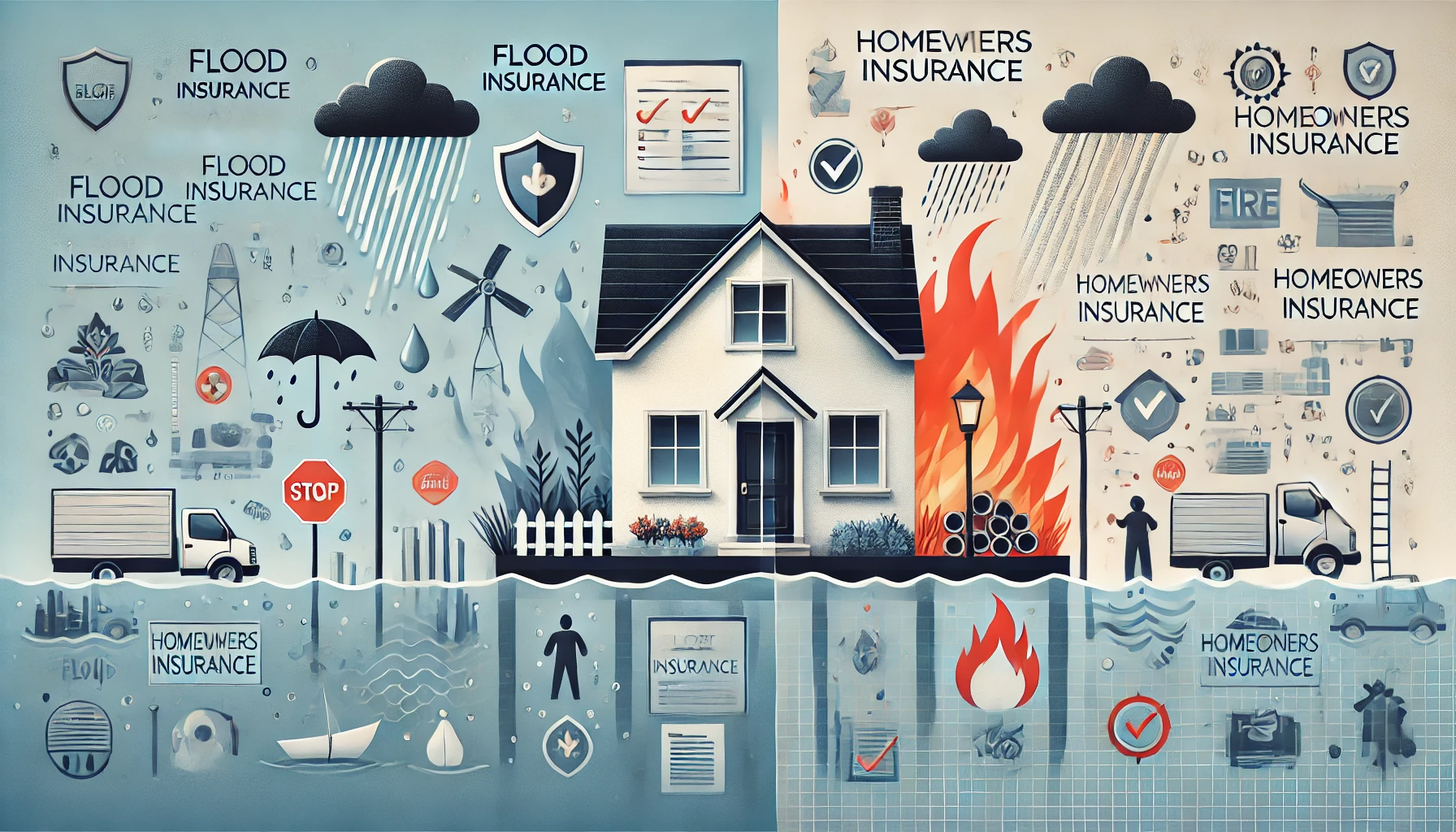
Think of homeowners insurance and flood insurance as two halves of one complete protection plan.
Here’s how they complement each other:
Homeowners insurance covers perils like fire, wind, hail, theft, and interior water leaks.
Flood insurance covers damage from external water sources — heavy rain, overflowing rivers, storm surges, and melting snow.
If a hurricane hits your town:
The wind damage to your roof? Covered by homeowners insurance.
The floodwater that enters your basement and damages your walls? Covered by flood insurance.
Without both, you’re only partially protected.
Real-Life Comparison: Homeowners Insurance vs. Flood Insurance in Action
Let’s look at a practical scenario:
A coastal storm hits your town. Strong winds tear off shingles, allowing rain to seep into your attic, while storm surges push three feet of seawater into your ground floor.
Here’s what happens:
Homeowners Insurance: Pays for the roof repairs and any water that entered through the damaged roof.
Flood Insurance: Pays for all structural and content damage caused by the rising seawater.
Without flood insurance, you’d lose the equivalent of half your coverage just when you need it most.
Who Should Absolutely Have Flood Insurance
Even if you’re not legally required to buy it, certain homeowners should absolutely carry flood coverage:
Those in low-lying or coastal areas — where storm surges or tidal events occur.
Urban residents — where heavy rain overwhelms drainage systems.
Owners of basements or below-ground spaces — highly vulnerable to water intrusion.
Homeowners with expensive finishes or mechanical systems on the lower floor.
Anyone who cannot afford to self-insure flood losses.
If replacing your flooring, HVAC, or electrical system after a flood would cripple your finances, flood insurance isn’t optional — it’s essential.
How to Check Your Property’s Flood Risk
You can easily find out your home’s flood zone using FEMA’s Flood Map Service Center (msc.fema.gov).
Steps:
Enter your address to view your flood map.
Identify your flood zone (A, AE, VE = high risk; X = low to moderate risk).
Consult your insurance agent or local floodplain manager for details on elevation and recent map changes.
You can also use private flood-risk tools like RiskFactor.com or FloodFactor for personalized projections, including rainfall and sea-level data.
Types of Flood Insurance Available
There are two main types of flood insurance available in the U.S.:
1. NFIP (National Flood Insurance Program)
Backed by the federal government
Standardized rates and limits (up to $250,000 for building, $100,000 for contents)
30-day waiting period before coverage starts
No coverage for additional living expenses
2. Private Flood Insurance
Offered by independent insurers
Often higher limits and flexible deductibles
May include coverage for basements, temporary housing, and replacement cost on contents
Can be cheaper for moderate-risk homes
Combining NFIP coverage for base protection with private flood insurance for add-ons is becoming an increasingly popular strategy.
The Peace of Mind Factor
Beyond financial protection, having flood insurance offers emotional peace of mind. Natural disasters bring enough stress — you don’t want to add financial panic to the mix.
When you carry both homeowners and flood insurance, you know every part of your home — from foundation to rooftop — is protected, no matter how extreme the weather becomes.
Families who’ve experienced floods often say the same thing: “The insurance check didn’t erase the pain, but it gave us hope.” That’s what true protection is about — resilience.
The Cost of Waiting Too Long
A flood insurance policy typically has a 30-day waiting period before it becomes active (except for certain mortgage-related purchases). That means you can’t buy it at the last minute when a storm is on the way.
Every year, homeowners try to purchase flood insurance right before hurricane season or a major storm warning, only to learn it won’t take effect until it’s too late.
Buying early ensures you’re protected year-round, with no gaps or delays.
Final Thoughts: If You Own a Home, You Need Both Policies
The simplest way to think about it:
Homeowners insurance protects you from fire, theft, and internal water damage.
Flood insurance protects you from rising water and natural flooding events.
If your home would be financially devastated by flood damage — even once in your lifetime — the small annual premium is more than worth it.
Disasters don’t follow maps or rules. Floods can hit anywhere, anytime. Owning both flood and homeowners insurance ensures your investment, your security, and your peace of mind are never washed away.
October 8, 2025
Home